Tag: Heidegger

  • Misogyny is Part of a Complex Ideology

    Often misogyny is part of a complex ideology. But it’s not clear which came first–the misogyny or the supporting ideology. For committed misogynists, hatred is a preference. Francis Parker Yockey and Baron Julius Evola were both misogynists. Kevin Coogan attributes this in large part to occult influences. The most prominent source of far right occult beliefs in the postwar period was Theosophy.

    Helena Petrovna Blavatsky

    Among Yockey’s possessions when the FBI arrested him was a citation for the June 1937 issue of The Theosophical Forum, an American journal of the Theosophy Society. The Russian-born mystic, Helena Petrovna Blavatsky founded the Theosophical society in New York City in 1875. In 1888, she published her book, The Secret Doctrine. Blavatsky’s doctrine basically turned the evolutionary worldview on its head. However, she had no intention of replacing evolution with biblical creationism. Her work resulted in countless forms and expressions of mischief.

    Root Races

    According to Blavatsky, the world has seen the rise and fall of seven “Root Races”. This rise and fall has taken place many times over. Now (in Blavatsky’s time) the Aryan, or fifth Root Race, dominates the world. However, the Aryans are at the end of a karmic cycle.

    Blavatsky taught that the Kali-Yuga was a time of great destruction. But its end was coming. This meant the beginning of the new Sixth Root Race. And the Sixth Root Race would begin the ascendancy of man toward the highest, Seventh Root Race of god-men.

    Curiously, Blavatsky’s Root Races were not biological entities. They were psychic entities. But in spite of this, her arguments were very influential for the racist right in both Germany and Austria. They ‘proved’ the Aryans were distant spiritual descendants of the highest root race, descended from the degenerate Atlantean tribes who themselves descended from the original god-men.

    Traditionalism vs Evolutionism

    The subterranean world of the high occult enveloped Yockey. Thanks to his occult interests, he saw himself as part of an underground elite, a secret new race of god-men. He wrote extensively about polarity and he developed sado-masochistic inclinations. To understand him, it is necessary to examine the writings of Julius Evola, the most important and most influential fascist high-occultist in postwar Europe.

    In his book, Revolt Against the Modern World. Evola argued that every epoch has its own myth. Democratic evolutionism is the Kali-Yuga’s myth. The myth of the new age, however, will be the Traditional worldview.

    Tradition teaches that mankind did not come from lower forms. It has higher origins. The lower represents a degeneration from the higher. Like Blavatsky, Evola claimed that today’s Aryans are the spiritual descendants of the highest root race. This highest root race was a ‘divine’ race. But it mixed its seed with the inferior human race, and so it is no longer with us.1

    Tradition, in more recent eras, developed a variety of myths referring to races as bearers of civilization and to the struggles between divine races and animal, cyclopic, or demonic races. They are the Aesir against the Elementarwesen; the Olympians and the heroes against giants and monsters of the darkness, the water, and the earth. They are the Aryan deva fighting against the asura, the enemies of the divine heroes; they are the Incas, the dominators who impose their solar laws on the aborigines who worshipped ‘Mother Earth’.

    Julius Evola, as quoted by Kevin Coogan p. 304

    As mentioned in a previous article, Evola was an early critic of Yockey’s Imperium. However, he merely thought Yockey was unrealistic about the timeframe of the fascist takeover. Evola and Yockey agreed on their basic ideology.

    René Guénon

    René Guénon was also an important figure in the European occult underground. Evola and Guénon had a disagreement about man’s relationship to the gods, however Guénon’s Traditionalism remained important within the European far right. And although Guénon eventually converted to Islam, he remained close to ‘traditionalist’ elements of the Catholic Church.

    Guénon taught that the modern age’s interest in democracy, mass culture, and materialism are all manifestations of the Kali-Yuga. The Kali-Yuga has infected thinking to the point where Western philosophy is purely human in character. Now philosophy is merely part of the rational order, which is inferior.

    The ideal order is a sort of genuine supra-rational and non-human traditional wisdom. Humans can’t achieve this kind of wisdom because ‘Truth’ is not a product of the human mind. It exists independently of ourselves. All we can do is apprehend it (Coogan, p. 294).

    Evola embraced this argument completely. He shared Guénon’s hatred of ‘mere human logos’. He believed that all the Renaissance had accomplished was to usher in the exaltation of the individual. Greece’s true zenith was not in the time of Socrates. It was during the mythical Heroic Age of Heracles.

    Traditionalism and the Un-human Ideal

    A human-like ‘personal God’ did not rule Evola’s universe. It was ruled by a numen. He defined a numen as an immutable naked force, an essence free of passion and change, one which creates distance with regard to everything which is merely human, a solar realm of Olympic peace and light, of divine regality. Borrowing from Guénon, he claimed this vision of pure being, the Hindu Satya-Yuga, corresponded in the West to Hesiod’s Golden Age.

    Like Spengler, he believed fascism was valuable only because it would bring on the dissolution of the old world in the Kali-Yuga. The old world’s destruction was necessary in order for the new age to arise. For Evola, fascism was merely a political form of Dada.

    Coogan on The Hermetic Tradition

    To help his readers understand Evola’s argument about God, Coogan examines Evola’s 1931 book The Hermetic Tradition. He reports that when Avaloka, a journal devoted to Hermetic thought, published a review from a section of Evola’s book, The Tree, the Serpent, and the Titan, the journal’s editor, Arthur Versluis, warned his readers that there is something Promethean, if not Luciferian, in Evola’s perspective. Coogan agrees (Coogan p. 296).

    The World Tree

    According to Evola’s ideology, the tree is an axis mundi joining two worlds: the solar world of immortality and timeless knowledge (Being) and the telluric world of Mother Earth (Becoming). This view associates Becoming with women, earth, and chaos symbols like dragons.

    In his book, Evola examines the dual symbolism of the Tree, namely its identification with notions of immortality and supernatural knowledge as well as its association with fatal and destructive forces like dragons, serpents, and demons. But of course Evola is talking about the World Tree. Coogan identifies three famous trees representing universal force. They are the Tree of the World, and the two biblical trees: the tree of life and the tree of knowledge. Each of them symbolizes the universal force linked to supernatural knowledge, immortality, and the power of domination. This universal force has a feminine nature.

    Misogyny is based on a complex ideology
    The Idea of a Danger. Credit: George Cotayo

    A Danger or a Promise?

    These trees also contain the idea of a danger. On the one hand, the tree symbolizes a temptation which brings ruin and damnation upon the one who succumbs to it. But it is also the object of conquest which transforms he who dares to undertake it into a God. It might even transfer the attributes of divinity and immortality from one race of beings to another.

    Adam tried to eat from the Tree of Knowledge and become godlike. He failed. But according to some legends, others have succeeded. These include the Hindu god Indra, Odin, Mithras, and Heracles. The legends tell us

    …of an undertaking which involved risk and a fundamental uncertainty. In Hesiod’s Theogony, and typically in the legend of the king of the Woods, Gods or exceptional men are seen as taking possession of power which can pass, along with the attributes of divinity, to whoever knows how to seize it…But among those who make the attempt, some force a way and triumph, and others fall, paying for their daring, experiencing the fatal effects of that same [primordial female] power.

    Julius Evola, as quoted by Coogan, p. 297

    Coogan objects to Evola’s presentation of this drama. He thinks the real question is whether man should even attempt to rival the gods. In mythology there are only two answers to this question, and they are in opposition to each other. They are the ‘magico-heroic’ answer and the religious answer.

    According to the magico-heroic view, he who attempts to become one with the gods but fails, is simply a being whose fortitude and good fortune were not equal to his daring. In the religious interpretation, however, such misfortune is changed to guilt, the heroic attempt [is changed] to a sacrilegious and cursed act not because of its failure, but in itself.

    Coogan, p. 297

    Adam
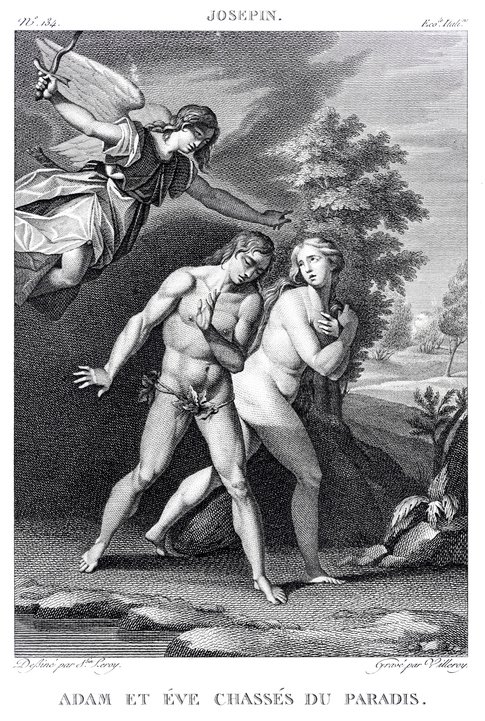
    Misogyny is Part of a Complex Ideology
    What happened to Adam is the only thing that could have happened to him. Credit: Grafissimo

    Coogan argues that what happens to Adam is the only thing that could have happened to him. Adam becomes one who has sinned. He has no alternative, therefore, but to seek expiation, and above all to renounce the wish which led him to that undertaking. The idea that the conquered can still think of reconquest, or intend to hold firm to the dignity which his act has earned him, appears from the religious perspective as ‘the most reprehensible Luciferism’ (Coogan p. 298). Yet, the heroic viewpoint persists.

    Hermes

    The Hermetic tradition represents the heroic viewpoint. Hermes is not only the messenger of the Gods; he is also one who succeeds. He takes from Zeus his scepter, from Venus her belt, and from Vulcan, the tools of his allegorical craft. In Egyptian tradition, Hermes became Hermes Trismegistus. He is the figure of one of the Kings and masters of the primordial age who gave man the principles of a higher civilization.

    The Fallen Angels
    Fallen Angels
    From Their Union Sprang the Nephilim or Watchers. Credit: francescoch

    We also have the account of fallen angels in the Book of Enoch. Coogan argues that it wasn’t merely their desire for the women that caused their downfall. There is power in woman’s relationship with the Tree, and power is what the angels were really after. When the angels became united to power, they fell and came to earth. They alighted on a high place of the earth (Mount Hermon), and from their union with the women sprang the Nephilim or Watchers. The Watchers teach the Royal Hermetic Art by which man can control the Gods.

    Evola updated and reissued The Hermetic Tradition in 1948. This was three years after the defeat of the ‘Heroes’ in World War II. For Evola, losing the war was not a metaphysical punishment. It was a simple defeat. He never stopped pursuing the quest for power/knowledge, for immortality, for domination over the Tree/Female. The Hermetic Tradition is a vision of a new race of men/gods.

    What Guénon and Evola Had in Common

    According to Coogan, Guénon was different than Evola. He thought Catholicism was the only tradition that could provide the ruling mythos for Europe (p. 300). But I think Coogan gives Guénon too much credit. In Guenon’s scheme, the elite will rule the world using primordial teachings found in several distinct traditions. But that is a discussion for another time.

    1. Kevin Coogan, Dreamer of the Day: Francis Parker Yockey and the Postwar Fascist International, Autonomedia, Brooklyn, New York, 1999, pp. 291-292 ↩︎

  • The Occult IMF

    Christine Lagarde’s strange occult speech given on January 15, 2014 inspired this article.  In this speech, she purposely called attention to numerology and then gave a series of misleading instructions on how to use it. This was during the time she was Managing Director of the International Monetary Fund (IMF). Because of the role the IMF plays today in our politics and economics, and because Legarde went to such trouble to call attention to numerology, it’s clear that the IMF is ‘The occult IMF’.

    Comparing Numerology in Orpheus the Fisher

    I’m using Robert Eisler’s book Orpheus the Fisher 1 to examine Lagarde’s references to numerology.  On page 267 Eisler begins a section entitled Number Symbolism in Aberkios’ Epitaph. This section is in the chapter entitled The ‘Fish’ caught by the ‘Virgin’ in the Mystic Epitaph of Bishop Aberkios.

    Who Was Aberkios?

    Eisler tells us that Aberkios was probably bishop Avirkios Markellos of Hieropolis in Phrygia Salutaris. According to the Church History of Eusebius, Aberkios lived towards the close of the 2nd century A.D. His epitaph incudes a number of words that are used in an unusual metaphorical sense. In other words, he uses a Christian mystery-language. He focuses on the various mystic epithets given to the ‘fish’ (p. 251). In these epethets we can distinguish between the reference to the Leviathan and the reference to ‘the suffering Messiah himself. Eisler says he intended the latter meaning.

    However, Eisler councils against insisting on the meaning, as ‘these expressions are intentionally mysterious.’ Instead, he believes we can guess the principle meaning of the document without knowing what dogma the poet had in mind. But even under these limitations, there is another surprise in store.

    Eisler thinks Aberkios Invited Christians to ‘Count the Number’

    Eisler thinks it can “be proved  that where Aberkios invites him ‘who understands this’ to pray for his soul, he means, even as the author of Rev. 13:18, also him ‘who has understanding to count the number,’ not only him who knows how to explain the mystery-words.” And  if we want to study this meaning, we should use the system found on inscribed tablets of the Dodonean oracle-priests and familiar to readers of Homer.

    Numeral Mysticism in Early Christian Literature

    Whatever had been known previously of numeral mysticism in Early Christian literature–e.g. the famous 666 in Revelations, the 888 for the name of Jesus (ΙΗΣΟΥΣ) in Marcus, the 801 = Omega-Alpha for the Dove (ΠΕΡΙΣΤΕΡΑ) of the Hoy Spirit, etc. –was al based, as well as the Pagan parallels of ‘Mithras’ (ΜΕΙΘΡΑΣ) or ‘Abraxas’ (ΑΒΡΑΞΑΣ) = 365, etc., on the so-called Milesian or common Greek system of expressing numbers by the letters of the alphabet, namely, A = 1, B = 2, Γ = 3 …Stigma = 6 …I = 10, IA = 11, …K = 20 …Koppa = 90, P = 100, etc.

    Yet Carl Robert had shown years ago that there existed another system of number-writing, anterior to this decimal mode, found e.g. on inscribed tablets of the Dodonean oracle-priests, etc., which is quite familiar to every reader of Homer as the twenty-four cantos of the Iliad and the Odyssey are simply numbered with the twenty-four sequent letters of the Greek alphabet

    These twenty-four sequent letters of the Greek alphabet are Α = 1, Β = 2, Γ = 3, . . . Κ = 10, Λ = 11, . . . Φ = 21, Χ = 22, Ψ = 23, Ω = 24—, without the supplementary signs Stigma, Koppa and Sampi used in the other series. Eisler tested the hypothesis of Wolfgang Schultz in his own book, Weltenmantel und Himmelszelt,[efn-note]On. ii. 70, pp. 164-166 (Hercher).[/efn-note] and he identifies it as the system used by the Orphic and Pythagorean mystics to conceal their innermost mystery-secrets.

    On the one hand, Eisler calls this method of deriving meanings from numbers ‘ridiculous futility’, but he thought it provided enough information for anyone ‘who had understanding to count the number’. This was important because they could prove to an adept of Pythagorean lore that the ‘name’ of Jesus, ‘into which’ the Christians were baptised, could be ‘put on’ even as a heavenly ‘garment’, instead of the ‘old man’ (Col. 3:9).

    “Putting on the Heavenly Garment” is Pagan, Not Jewish

    This concept comes from the Pagan mysteries. It was alien to the old Jewish cult-system. However, Paul used this simile himself. (Eisler assumes he was under the influence of Hermeticism.) But the concept was also used in John 21, and possibly his source in Mark.

    Eisler concludes that it is worthwhile to study this system ‘if it is in keeping with other features of the narrative, for example the precise numbers full of symbolic bearing that are given for the cubits over which Peter has to swim from the boat to the Lord Jesus, and the multitude of ‘great fishes’ caught in the Apostle’s net. Eisler lists many other examples, but to include them all in this article would be getting off the subject.

    The Magic Number 7 in Lagarde’s Occult IMF Speech

    At the beginning of Lagarde’s occult IMF speech she mentions the ‘magic number 7’, saying that it’s ‘in all sorts of themes and religions’. She also explains that the numbers should be compressed. However, if she was serious about counting the number, she should have explained which system she was using. Her method made no sense.

    My Calculations Find the Magic Number 7 In Events She Mentions but Doesn’t Calculate

    Beginning with the date of Lagarde’s speech, both January 15 and 2014 equal 7: 01 + 1 + 5 = 7 and 2 + 1 + 4 = 7. In other words, the entire date equals 14, not just the last two digits of the year as she claimed.

    If we use the Greek letters for January, we get the same result. January in Greek is Ιανουȧριος, or 9 + 1 + 13 + 15 + 20 + 1 + 17 + 9 + 15 + 18 = 118. Compressing 118 gives 1 + 1 + 8 = 10. So again that’s: 1 + 0 + 1 + 5 = 7.

    The 100th Anniversary of World War I

    Next she tells us that 2014 will mark the 100th anniversary of World War I. The date of the beginning of World War I, June 28, 1914, doesn’t give us a 7 in the same way that January 15, 2014 does. Perhaps it’s not relevant. However the number 28 is important as the fulfillment of the number 7: 1 + 2 + 3 + 4 + 5 + 6 + 7 = 28.

    The 70th Anniversary of the Bretton Woods Conference

    Then she says 2014 is also the ‘70th anniversary of the Bretton Woods conference which gave birth to the IMF’. The 70 compresses to 7.  International Monetary Fund compresses to 7.

    The 25th Anniversary of the Fall of the Berlin Wall

    Next she says, it’s the 25th anniversary of the fall of the Berlin Wall. 2 + 5 = 7.

    The Berlin Wall fell November 9, 1989. November in Greek is Νοεμβριος. This is 13 + 15 + 5 + 12 + 2 + 17 + 9 + 15 + 18 = 106, which compresses to 7.

    1989 is 1 + 9 + 8 + 9 = 27. (Compressed this is 9, however the number 27 may be important in itself.)  November 9, 1989 is 106 + 9 + 27 = 142. 1 + 4 + 2 = 7.

    The 7th Anniversary of ‘Financial Jitters’

    Next, she tells us that 2014 marks the 7th anniversary of the ‘financial jitters that turned into the greatest global catastrophe since the Great Depression’. The 7th anniversary comment looks to be the main relevance of this date as well.

    It’s not hard to guess why she chose January 15 for an occult speech in the year 2014, but what do the correspondences mean? Is she hinting that her cabal had a hand in those events? Unfortunately this system can be used to ‘prove’ just about anything, so it’s anyone’s guess.

    Lagarde Emphasizes ‘Weakness’

    However there several things in this speech we can talk about without feeling ridiculous. I’ll deal in this post with one interpretation of Lagarde’s emphasis on weakness. She described the previous 7 years as ‘weak and fragile’.

    By coincidence, I was researching the relationship between the theories of Joachim of Fiore & secularism and found an article about Gianni Vattimo that seems relevant.  2Gianni Vattimo, (1936–) Internet Encyclopedia of Philosophy: a peer-reviewed academic resource.[/efn-note] I realize the connection of Vattimo with the IMF is random but it’s amazing how well it fits.

    Gianni Vattimo

    Vattimo is an Italian philosopher and cultural commentator, who is currently a Member of the European Parliament and a gay rights activist. He is influenced by Joachim of Fiore, but also by the works of Nietzsche, Heidegger, Gadamer and Kuhn. His ideas have influence across disciplines such as feminism, theology, sexuality studies, and globalization.

    Vattimo is “well known for his philosophical style of ‘weak thought’ (pensiero debole). ‘Weak thought’ is an attempt to understand and re-configure traces from the history of thought in ways that accord with postmodern conditions. In doing so, the aim of ‘weak thought’ is to create an ethic of ‘weakness’…” But what does this entail?

    The Ethic of Weakness is Vattimo’s Versions of  the Decline of the West Theme

    Vattimo, an ‘End of History’ type of philosopher, believes there is no longer a coherent narrative which is accepted in the West. In his view this process is a positive thing–it was initiated by Jesus Christ who  came to expose society’s propensity for sacrificial religion.

    Vattimo posits that history has lost its unilinear character in three principle ways: theoretically, demographically, and through mass communication. To explain the theoretical process he uses Walter Benjamin, who argues that unilinear history is a product of class conflict. Vattimo thinks demographic effects in modern Europe, in particular mass migration, have acted to undermine the notion of Europe’s unilinear history. This process is aided by mass communication which facilitates the rebellion of previously ruled peoples. In his view, the chaotic aspect of mass communication will lead to ‘emancipation’.

    This view contrasts with that of Adorno, Horkheimer, and Orwell, who thought that a homogenization of society would result from mass communication. As a result of Vattimo’s reading of Nietzsche, he thinks mass communication will lead to an increase of interpretations rather than facts.

    The Contradictions and Hypocrisy in Vattimo’s Diagnosis of Late Modernity

    Vattimo’s philosophy is not free of contradictions and hypocrisy. In spite of his supposed acceptance of a variety of interpretations, he firmly believes that his diagnosis of the situation of late modernity makes the best possible sense of this interpretative plurality.

    In another example he accepts the wearing of a cross as part of the secular furniture of the West but he rejects the wearing of the chador, which he thinks is an example of strong thought.  Never mind that the chador could be worn out of choice in a ‘weak’ sense. (Vattimo is an atheist but he was educated as a Catholic.)

    Weak Thought is an Agenda

    Weak thought is Vattimo’s philosophical style but it’s also his agenda.  It has lead him to posit that the only plausible late-modern, Western philosophical outlook is ‘hermeneutical nihilism’.” According to Vattimo, one must weaken the traces of the tradition into which one is ‘thrown’, and this can be done by twisting the old traces of Being. (Hermeneutics is a branch of knowledge that deals with interpretation, especially of the Bible or literary texts.)

    “Determined in this manner, Vattimo’s philosophy of ‘weak thought’ involves a withdrawal from metaphysics by avoiding new foundations or complete assent to any position.”

    Conclusion

    Although this philosophy is all wrapped up in a new package, it’s not new at all.  In fact it’s been proven over and over again to be harmful.   Unfortunately our illustrious leaders have no objection to it.

    Lagarde’s speech was part of an abusive relationship. She is a powerful representative of a powerful institution who gives us false and misleading information and then allows us struggle to understand.

    The abuse continues today.  We’ve seen the destruction of Syria, blatant disrespect for the US electoral process, and the bulldozing of tribal burial grounds in North Dakota, all directly related to out-of-control corporate power.

    Philosophy is one thing. Imposing one’s philosophy on the physical world and then teasing people with this magical nonsense is another thing entirely. It should go without saying that this behavior is not acceptable.

error: Content is protected !!