Tag: Julius Evola

  • Misogyny is Part of a Complex Ideology

    Often misogyny is part of a complex ideology. But it’s not clear which came first–the misogyny or the supporting ideology. For committed misogynists, hatred is a preference. Francis Parker Yockey and Baron Julius Evola were both misogynists. Kevin Coogan attributes this in large part to occult influences. The most prominent source of far right occult beliefs in the postwar period was Theosophy.

    Helena Petrovna Blavatsky

    Among Yockey’s possessions when the FBI arrested him was a citation for the June 1937 issue of The Theosophical Forum, an American journal of the Theosophy Society. The Russian-born mystic, Helena Petrovna Blavatsky founded the Theosophical society in New York City in 1875. In 1888, she published her book, The Secret Doctrine. Blavatsky’s doctrine basically turned the evolutionary worldview on its head. However, she had no intention of replacing evolution with biblical creationism. Her work resulted in countless forms and expressions of mischief.

    Root Races

    According to Blavatsky, the world has seen the rise and fall of seven “Root Races”. This rise and fall has taken place many times over. Now (in Blavatsky’s time) the Aryan, or fifth Root Race, dominates the world. However, the Aryans are at the end of a karmic cycle.

    Blavatsky taught that the Kali-Yuga was a time of great destruction. But its end was coming. This meant the beginning of the new Sixth Root Race. And the Sixth Root Race would begin the ascendancy of man toward the highest, Seventh Root Race of god-men.

    Curiously, Blavatsky’s Root Races were not biological entities. They were psychic entities. But in spite of this, her arguments were very influential for the racist right in both Germany and Austria. They ‘proved’ the Aryans were distant spiritual descendants of the highest root race, descended from the degenerate Atlantean tribes who themselves descended from the original god-men.

    Traditionalism vs Evolutionism

    The subterranean world of the high occult enveloped Yockey. Thanks to his occult interests, he saw himself as part of an underground elite, a secret new race of god-men. He wrote extensively about polarity and he developed sado-masochistic inclinations. To understand him, it is necessary to examine the writings of Julius Evola, the most important and most influential fascist high-occultist in postwar Europe.

    In his book, Revolt Against the Modern World. Evola argued that every epoch has its own myth. Democratic evolutionism is the Kali-Yuga’s myth. The myth of the new age, however, will be the Traditional worldview.

    Tradition teaches that mankind did not come from lower forms. It has higher origins. The lower represents a degeneration from the higher. Like Blavatsky, Evola claimed that today’s Aryans are the spiritual descendants of the highest root race. This highest root race was a ‘divine’ race. But it mixed its seed with the inferior human race, and so it is no longer with us.1

    Tradition, in more recent eras, developed a variety of myths referring to races as bearers of civilization and to the struggles between divine races and animal, cyclopic, or demonic races. They are the Aesir against the Elementarwesen; the Olympians and the heroes against giants and monsters of the darkness, the water, and the earth. They are the Aryan deva fighting against the asura, the enemies of the divine heroes; they are the Incas, the dominators who impose their solar laws on the aborigines who worshipped ‘Mother Earth’.

    Julius Evola, as quoted by Kevin Coogan p. 304

    As mentioned in a previous article, Evola was an early critic of Yockey’s Imperium. However, he merely thought Yockey was unrealistic about the timeframe of the fascist takeover. Evola and Yockey agreed on their basic ideology.

    René Guénon

    René Guénon was also an important figure in the European occult underground. Evola and Guénon had a disagreement about man’s relationship to the gods, however Guénon’s Traditionalism remained important within the European far right. And although Guénon eventually converted to Islam, he remained close to ‘traditionalist’ elements of the Catholic Church.

    Guénon taught that the modern age’s interest in democracy, mass culture, and materialism are all manifestations of the Kali-Yuga. The Kali-Yuga has infected thinking to the point where Western philosophy is purely human in character. Now philosophy is merely part of the rational order, which is inferior.

    The ideal order is a sort of genuine supra-rational and non-human traditional wisdom. Humans can’t achieve this kind of wisdom because ‘Truth’ is not a product of the human mind. It exists independently of ourselves. All we can do is apprehend it (Coogan, p. 294).

    Evola embraced this argument completely. He shared Guénon’s hatred of ‘mere human logos’. He believed that all the Renaissance had accomplished was to usher in the exaltation of the individual. Greece’s true zenith was not in the time of Socrates. It was during the mythical Heroic Age of Heracles.

    Traditionalism and the Un-human Ideal

    A human-like ‘personal God’ did not rule Evola’s universe. It was ruled by a numen. He defined a numen as an immutable naked force, an essence free of passion and change, one which creates distance with regard to everything which is merely human, a solar realm of Olympic peace and light, of divine regality. Borrowing from Guénon, he claimed this vision of pure being, the Hindu Satya-Yuga, corresponded in the West to Hesiod’s Golden Age.

    Like Spengler, he believed fascism was valuable only because it would bring on the dissolution of the old world in the Kali-Yuga. The old world’s destruction was necessary in order for the new age to arise. For Evola, fascism was merely a political form of Dada.

    Coogan on The Hermetic Tradition

    To help his readers understand Evola’s argument about God, Coogan examines Evola’s 1931 book The Hermetic Tradition. He reports that when Avaloka, a journal devoted to Hermetic thought, published a review from a section of Evola’s book, The Tree, the Serpent, and the Titan, the journal’s editor, Arthur Versluis, warned his readers that there is something Promethean, if not Luciferian, in Evola’s perspective. Coogan agrees (Coogan p. 296).

    The World Tree

    According to Evola’s ideology, the tree is an axis mundi joining two worlds: the solar world of immortality and timeless knowledge (Being) and the telluric world of Mother Earth (Becoming). This view associates Becoming with women, earth, and chaos symbols like dragons.

    In his book, Evola examines the dual symbolism of the Tree, namely its identification with notions of immortality and supernatural knowledge as well as its association with fatal and destructive forces like dragons, serpents, and demons. But of course Evola is talking about the World Tree. Coogan identifies three famous trees representing universal force. They are the Tree of the World, and the two biblical trees: the tree of life and the tree of knowledge. Each of them symbolizes the universal force linked to supernatural knowledge, immortality, and the power of domination. This universal force has a feminine nature.

    Misogyny is based on a complex ideology
    The Idea of a Danger. Credit: George Cotayo

    A Danger or a Promise?

    These trees also contain the idea of a danger. On the one hand, the tree symbolizes a temptation which brings ruin and damnation upon the one who succumbs to it. But it is also the object of conquest which transforms he who dares to undertake it into a God. It might even transfer the attributes of divinity and immortality from one race of beings to another.

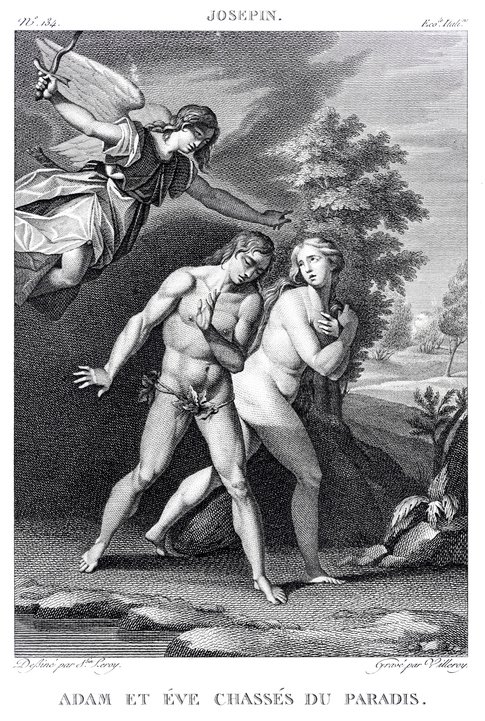
    Adam tried to eat from the Tree of Knowledge and become godlike. He failed. But according to some legends, others have succeeded. These include the Hindu god Indra, Odin, Mithras, and Heracles. The legends tell us

    …of an undertaking which involved risk and a fundamental uncertainty. In Hesiod’s Theogony, and typically in the legend of the king of the Woods, Gods or exceptional men are seen as taking possession of power which can pass, along with the attributes of divinity, to whoever knows how to seize it…But among those who make the attempt, some force a way and triumph, and others fall, paying for their daring, experiencing the fatal effects of that same [primordial female] power.

    Julius Evola, as quoted by Coogan, p. 297

    Coogan objects to Evola’s presentation of this drama. He thinks the real question is whether man should even attempt to rival the gods. In mythology there are only two answers to this question, and they are in opposition to each other. They are the ‘magico-heroic’ answer and the religious answer.

    According to the magico-heroic view, he who attempts to become one with the gods but fails, is simply a being whose fortitude and good fortune were not equal to his daring. In the religious interpretation, however, such misfortune is changed to guilt, the heroic attempt [is changed] to a sacrilegious and cursed act not because of its failure, but in itself.

    Coogan, p. 297

    Adam

    Misogyny is Part of a Complex Ideology
    What happened to Adam is the only thing that could have happened to him. Credit: Grafissimo

    Coogan argues that what happens to Adam is the only thing that could have happened to him. Adam becomes one who has sinned. He has no alternative, therefore, but to seek expiation, and above all to renounce the wish which led him to that undertaking. The idea that the conquered can still think of reconquest, or intend to hold firm to the dignity which his act has earned him, appears from the religious perspective as ‘the most reprehensible Luciferism’ (Coogan p. 298). Yet, the heroic viewpoint persists.

    Hermes

    The Hermetic tradition represents the heroic viewpoint. Hermes is not only the messenger of the Gods; he is also one who succeeds. He takes from Zeus his scepter, from Venus her belt, and from Vulcan, the tools of his allegorical craft. In Egyptian tradition, Hermes became Hermes Trismegistus. He is the figure of one of the Kings and masters of the primordial age who gave man the principles of a higher civilization.

    The Fallen Angels

    Fallen Angels
    From Their Union Sprang the Nephilim or Watchers. Credit: francescoch

    We also have the account of fallen angels in the Book of Enoch. Coogan argues that it wasn’t merely their desire for the women that caused their downfall. There is power in woman’s relationship with the Tree, and power is what the angels were really after. When the angels became united to power, they fell and came to earth. They alighted on a high place of the earth (Mount Hermon), and from their union with the women sprang the Nephilim or Watchers. The Watchers teach the Royal Hermetic Art by which man can control the Gods.

    Evola updated and reissued The Hermetic Tradition in 1948. This was three years after the defeat of the ‘Heroes’ in World War II. For Evola, losing the war was not a metaphysical punishment. It was a simple defeat. He never stopped pursuing the quest for power/knowledge, for immortality, for domination over the Tree/Female. The Hermetic Tradition is a vision of a new race of men/gods.

    What Guénon and Evola Had in Common

    According to Coogan, Guénon was different than Evola. He thought Catholicism was the only tradition that could provide the ruling mythos for Europe (p. 300). But I think Coogan gives Guénon too much credit. In Guenon’s scheme, the elite will rule the world using primordial teachings found in several distinct traditions. But that is a discussion for another time.

    1. Kevin Coogan, Dreamer of the Day: Francis Parker Yockey and the Postwar Fascist International, Autonomedia, Brooklyn, New York, 1999, pp. 291-292 ↩︎

  • Divisions in the Postwar Fascist International

    Oswald Spengler was inside the Munich Beer Hall on November 8, 1923, when Hitler launched his putsch. Such encounters convinced him that the Nazis were the worst sort of proletarized street rabble. But although he cultivated an aura of political detachment, he was highly political. He wrote Prussianism and Socialism in 1919, in which he took part in the struggle against Russian-style Marxism, German social democracy, and Weimar liberalism. He once transferred funds from a right-wing German politician and former Krupp director named Alfred Hugenberg to one of the Bavarian paramilitary leagues known as the kampfbunde (Coogan pp. 58-59). This was the beginning of divisions in the postwar Fascist International.

    The Right-wing versus the Nazis

    Spengler was right-wing, but he was not a Nazi. As a political monarchist, he thought real government must be aristocratic, since every nation in history was led by an aristocratic minority. He voted for Hitler in the 1932 elections as part of a broad conservative bloc, but he believed that movements like Nazism were symptoms of Europe’s decline. Hitler’s populist rhetoric, as well as the Nazis’ hooliganism and pandering to the masses, reflected Germany’s problem rather than its solution. 

    In The Hour of Decision, Spengler attacked the political left for its noisy agitation as a foundation for individual power. But Ernst Roehm’s Stormtroopers were just as bad. Spengler also criticized Italian Fascism. 

    For Fascism is also a transition. It had its origin in the city mobs and began as a mass party with noise and disturbance and mass oratory; Labor-Socialist tendencies are not unknown to it. But so long as a dictatorship has ‘social service’ ambitions, asserts that it is there for the ‘worker’s’ sake, courts favor in the streets, and is ‘popular,’ so long it remains an interim form. The Caesarism of the future fights solely for power, for empire, and against every description of party (Coogan p. 59).1

    Spengler Falls Out With the Nazis

    The year Spengler’s book was published, 1933, was also the year the Nazis took power. The Nazis courted him at first, but when his book became an instant bestseller they tried to halt sales. They attacked Spengler’s ‘ice-cold contempt for the people,’ his worship of aristocratic and monarchist society, his pessimism, and his denial of race. (To be clear, Spengler, Francis Parker Yockey and others who argued against the racial basis for anti-Semitism, had no more love for the Jews than the Nazis did. They believed in Jew hatred, but in a more spiritual form.) 

    It didn’t take long for Hitler’s archivists to discover that Spengler’s great grandfather, Frederick Wilhelm Grantzow, was partly Jewish. In addition, Spengler was too close to Germany’s old ruling classes for comfort. His allies included wealthy business magnates and right-wing nobles like former German chancellor Franz von Papen. Last but not least, Spengler was not an anti-Semitic conspiracy theorist. 

    Educated Germany’s Contempt for Judaism, Islam and Christianity

    Spengler shared the view of many educated Germans that Judaism was an exhausted belief system that had played out its historic vitality many centuries ago and only survived in Europe’s ghettos like a fossil preserved in amber. And these educated Germans were not any more friendly to Islam and Christianity. Spengler and his ilk even included the Nazi Volk in this group. He believed all of these belief systems were world-denying, escapist, and anti-historical. In his view, Western antipathy was not due to racism at all. It was cultural.

    The Fascists Cherry-Pick Spengler’s Ideas

    Francis Parker Yockey was completely on board with this view of race. However, unlike Spengler, he believed Hitler was ‘The Hero’, or the new Caesar, not because of but in spite of his ‘plebian racial musings’ (Coogan p 61). 

    Yockey Learns about Carl Schmitt at Georgetown

    Carl Schmitt was Germany’s leading Catholic International and constitutional law theorist and an advisor to Franz von Papen during the Weimar period. He joined the NSDAP May 1933. Yockey became a devotee of Schmitt while studying at Georgetown University.

    Yockey plagiarized Schmitt in Imperium. His defense of Machiavelli sounds eerily similar to that of Jacobin. Machiavelli’s book was defensive because Frenchmen, Germans, Spaniards, and Turks had invaded Italy during his century.

    When the French Revolutionary Armies occupied Prussia, and coupled humanitarian sentiments of the rights of Man with brutality and large-scale looting, Hegel and Fichte restored Machiavelli once again to respect as a thinker. He represented a means of defense against a foe armed with a humanitarian ideology. Machiavelli showed the actual role played by verbal sentiments in politics (Yockey, as quoted by Coogan, pp. 74-75) 

    Carl Schmitt, the Conservative Revolution, the State of Exception, and the Messiah

    Spengler inspired a Weimar intellectual current known as the Conservative Revolution. Novelist Ernst Junger and Martin Heidegger were part of it. They believed liberalism, democracy, individualism, and Enlightenment rationalism were part of a superficial and materialistic capitalist society. When the liberal order collapses, a new virile man of adventure will arise–a kind of Western ronin willing to risk all and with a mystical belief in the state. 

    Schmitt particularly despised Weimar parliamentary democracy. His theory for overcoming constitutional rule was the ‘state of exception, or ‘legal positivism’. This meant suspending the constitution during a crisis. He believed ending the constitutional order opened a path for a new heroic ‘politics of authenticity’. 

    Like Spengler, Schmitt saw the state as supreme. He believed government proceeded in three dialectic states: from the absolute state of the 17th and 18th centuries; through the neutral state of the liberal 19th century; to the totalitarian state in which state and society are identical. 

    Father Walsh observed that the final stage of Schmitt’s idea ‘was the monopoly of all power, all authority, all will in the Führer, conceived and accepted as Messiah endowed with unlimited legal prerogatives in a state under perpetual martial law.’ 

    Schmitt Endorsed Hitler’s Night of the Long Knives

    Schmitt endorsed Hitler’s bloodletting on The Night of the Long Knives, but the killing cut both ways. Hitler also used the purge to intimidate his potential rivals in the old military and political establishment who had given him political respectability. He even murdered one of Franz von Papen’s closest aides. The following quote is the Nazi challenge to the old guard.

    “If we had relied upon those suave cavaliers (the reactionaries), Germany would have been lost. These circles sitting in armchairs in their exclusive clubs, smoking big cigars and discussing how to solve unemployment, are laughable dwarfs, always talking and never acting. If we stamp our feet, they will scurry to their holes like mice. We have the power and we will keep it” (Joseph Goebbels, June 1934, as quoted by Coogan, p. 77). 

    The Nazi’s Turn Against Schmitt

    In 1936, the Nazis turned on Schmitt and began investigating his ‘non-Aryan’ wife. The SS organ Das Schwarze Korps regularly threatened him. According to Coogan, this was simply a power-play by Himmler to seize total police and judicial power.

    Schmitt Retreats to Geopolitics with His Grossraum Theory

    In response, Schmitt turned to international law. In 1939, he gave a speech to the Institute of Politics and International Law at the University of Kiel about the legitimacy of an extraterritorial order, a ‘great space order.’ His rationale: the nation-state system had broken down. Now the world had the British, Soviet and American empires, as well as Japan’s Greater East Asia Co-prosperity Sphere. These dwarfed older concepts of ‘nation.’ Enormous shifts in state power demanded corresponding shifts in international law. Grossraum was the proper way forward. Grossraum referred to an area dominated by a power. This would not be the result of organic geopolitical expansion but of a ‘political idea’. Schmitt had in mind a German-dominated Central Europe. This was a political idea distinct from its two universalist opponents–the laissez-faire ideology of Anglo-Saxon capital and the equally universalist Communist ideology. It was a German version of the American Monroe Doctrine. 

    This impressed Hitler. It also influenced Chamberlain’s agreement with Hitler over Eastern Europe’s 1939 Munich Agreement. 

    Yockey Objects to Schmitt’s Materialism; Haushofer Praises Schmitt; the Nazis Defend the Third Reich’s Racial Justification

    Yockey’s criticism of Schmitt focused on Schmitt’s materialism. He said the traditional geopolitics of Schmitt was based on physical facts or geography. Instead, the soul is primary. But at the same time, he believed Schmitt’s researches had permanent value and that large-space thinking was essential.

    Yockey praised Haushofer; Haushofer supported Schmitt; and the Nazis disagreed with Haushoffer and Schmitt. Haushofer thought Europe needed a concept like pan-Slavism or pan-Asianism–ideas seeking to manifest themselves in space. Nazi racialists argued that pan-Slavism or pan-Asianism would remove the racist justification from the concept of the German Reich. 

    Yockey and Newton Jenkins

    While Yockey was attending Northwestern’s law school in Chicago, he served as a ‘kind of aide-de-camp’ to a lawyer and important right-wing activist named Newton Jenkins. Jenkins had found his way to fascism from the progressive movement.

    Jenkins went to school at Ohio State and Columbia University’s Law School. After serving in World War I, he returned to the Midwest and became legal counsel for many farm groups and agricultural cooperatives. He also began working closely with the Progressive Party and used his radio program to support FDR for President. However, in 1932 he ran for senate in the Republican Party’s primary and was able to win 400,000 votes. 

    The Yockey-Jenkins connection came to the FBI’s attention through an informant. This informant had seen a March 31,1954 column by Drew Pearson, which attacked Soviet ties to the far right. In his column, Pearson revealed that the FBI was interested in Varange (Yockey’s pen name in Imperium), and he identified Varange as Francis Parker Yockey. As a result, a former acquaintance of Yockey’s from the late 1930s contacted the FBI. According to FBI files, this informant met Yockey in 1938 at the Chicago office of Newton Jenkins. An excerpt from the report follows.

    _______recalls that Yockey was an intense, secretive, bitter individual who did not tolerate anyone who would not wholeheartedly agree with his solution to world problems…_______stated that…Yockey was ‘power hungry’ and gave the impression that he would not stop until he became the most powerful individual in the world. _______believes that Yockey will not succeed in this because he creates too may enemies. ________feels that Yockey will go along with any program whether it stemmed from Moscow, Buenos Aires, Yorkville, Tokyo or Washington, D.C., as long as he can be the leader. ________stated that Yockey believed that the world capitalist structure was about to crumble and that fascism was the only solution, but he insisted that it be the Yockey form of fascism and none other…

    Coogan pp. 85-86

    Jenkins Progressivism

    Jenkins was active in promoting the America First Committee the Keep America Out of War Committee, and similar organizations working for the defeat of Russia and Communism. He also maintained ties to the German American Bund. According to George Britt’s 1940 book, The Fifth Column is Here, Jenkins has an extensive record of pro-Hitler comments. Also, Jenkins attempted to unite fascist and Nazi groups into a third political party. This led the Bund to christen him The Leader of the Third Party (cited by Coogan).

    Jenkins Makes a Right Turn

    Jenkins began his right turn in 1934 when he formed The Third Party under the slogan ‘U.S. Unite?’ Party headquarters was 39 South La Salle Street, the same office where the FBI informant had met Yockey. In his pamphlet, The Third Party, Jenkins portrayed himself as a progressive opposed to big business. He explained that he was founding his new organization because Franklin Roosevelt had backed down on implementing the more radical aspects of the New Deal. He also warned that the British Empire had too much influence over American foreign policy. 

    Jenkins favored active government intervention in the economy and thought Mussolini’s Italy and Hitler’s Germany were models for America. To support his efforts, Jenkins began contacting Hitler’s supporters in the ‘Friends of the New Germany‘, which soon became the German-American Bund. 

    The German-American Bund, the Union Party, and Jenkins’s Ambition to Unite 125 Rightist Groups

    In 1936, Jenkins became campaign manager for the Union Party, which turned out to be the most significant third-party challenge to FDR. After the Party’s defeat, Jenkins maintained relations with the Bund. He spoke at the Bund’s 1937 National Convention at Camp Siegrried in New York. He then launched his own paper, American Nationalism, which served as the propaganda arm of yet another Jenkins organization, the American Nationalist Political Action Clubs (ANPAC). This organization aimed to unite over 125 rightist groups into a coordinated movement (Coogan, pp. 87-88). 

    Yockey Was a Weimar ‘New Right’ Anti-American

    Yockey’s attraction to both Spengler and Conservative Revolution theorists like Carl Schmitt made him virtually unique in the American far right. American supporters of Nazi Germany were usually German Americans, crude anti-Semitic nativists, or staunch conservatives who viewed Hitler as a heaven-sent bulwark against Bolshevism. By contrast, Yockey represented a Nazified version of the Weimar “New right” Conservative Revolutionary current. 

    Yockey devoted over a hundred pages of Imperium to describing an America incapable of ‘destiny thinking’. In this he was heavily dependent on Oswald Spengler, who had the following to say about ‘hundred percent Americanism‘:

    A mass existence standardized to a low average level, a primitive pose, or a promise for the future?…America with its ‘intellectually primitive upper class, obsessed as it is by the thought of money, lacked that element of historic tragedy, of great destiny, that has widened and chastened the soul of Western peoples through the centuries. America was little more than a boundless field and a population of trappers, drifting from town to town in the dollar-hunt, unscrupulous and dissolute, for the law is only for those who are not cunning or powerful enough to ignore it (Spengler paraphrased by Coogan p. 132).

    Spengler goes on to liken the United States to the Russian form of State socialism or State capitalism. It doesn’t grow organically. It grows through soulless mechanization. (You will recall that the idea of an ‘organic’ state was the first heresy of German geopolitics according to Father Walsh. Here Spengler faults the United States for growing mechanically, rather than organically.) 

    Yockey was every bit as insulting as Spengler. Coogan sums Yockey’s arguments up this way: ‘A Nation, in short, is a people containing a Cultural Idea. Because America lacks a Cultural Idea, America, by definition, is not a nation.’

    Yockey also faults what he called the ‘Rationalist Religion’ of America’s Founding Fathers. He argued that this ‘Religion’ came from England through France. But rationalism did not dominate Europe until the 19th century, thanks to Europe’s tradition. America never had this tradition. Furthermore, America’s rationalist and materialist ideology made her vulnerable to domination by the Jewish ‘culture-distorter’. 

    Yockey’s racism was intense and visceral (Coogans words). It also had ideological roots. Coogan supports this argument with quotes from Hegel’s The Philosophy of History. Yockey was dealing with his own racism, Hegel’s influence, and Spengler’s description of great cultures (Coogan p. 135). For more of Yockey’s criticism of America see Coogan’s Chapter 14, Empire of the Senseless

    Imperium: a New Kind of Fascism

    Coogan says the enthusiasm of rightist leaders for Yockey’s book, Imperium, reflected a need for a new kind of fascism. He cites the call for a united Europe by Sir Oswald Mosley. Mosley envisioned ‘a great unity imbued with a sense of high mission, not a market state of jealous battling interests.’ 

    The Right’s Doubts About Yockey

    But Mosley turned against Yockey. Mosley not only declined to publish Imperium, he blocked a promised review in the Union Movement paper. This brought much criticism from prominent members of Mosley’s group who wanted more dynamic leadership. Mosley’s biographer Robert Skidelsky explained Mosley’s rationale.

    It was part of a process of Mosley’s extrication from the dead hand of pre-war fascism and a rededication to a new, and more moderate crusade. This meant coming to terms with American hegemony over Western Europe. It was this approach that Yockey opposed. 

    While still in Mosley’s group, Yockey had had discussions about the American question with A. Raven Thomson, one of Mosley’s closest aides. Thomson later wrote in a letter to H. Keith Thompson that Mosley had refused to finance Yockey’s book because it was full of Spenglerian pessimism and unnecessarily offensive to America. After Yockey broke with Mosley’s group, they found him to be ‘so conceited and unstable in personal relations that it is almost impossible to work with him‘ (Coogan, p. 171). 

    Coogan adds a historical explanation for the break: The political climate in Europe in 1948 had become dangerous, with the Berlin Crisis raising the possibility of war. Suddenly the fascist ‘third way’ was called into question. 

    Yockey Turns to the East

    Eventually, Yockey’s book was financed by Baroness Alice von Pilugl. It was during his association with Pilugl that Yockey began advocating far-right cooperation with the Russian conquest of Europe (Coogan p. 172). And this was not the only attempt to ally the radical right with the USSR.

    An anti-Yockey British-German group called NATINFORM (the Nationalist Information Bureau) observed Yockey’s meetings. By 1950, it was clear that Yockey et al were promoting a definite line of policy and seeking collaborators. The main trend of this policy was based on Imperium and Yockey’s concepts. In July of 1950, Guy Chesham, who was acting as a representative of Yockey, outlined a policy of infiltrating into all Nationalist groups with a view to seizing control from within or organizing sabotage. 

    The political direction of this activity was to be violently anti-American, avoiding all anti-Bolshevist conceptions. No anti-Jewish propaganda was to be permitted [at] first (Coogan pp. 173-174).

    Yockey Has Company

    Yockey was not acting alone in this effort. The right-radical Socialist Reich Party (SRP) was founded in Germany aroung the time of Imperium’s publication. It called for a pro-Eastern neutralist Germany, which was almost identical to Yockey’s position. Yockey’s organization, The European Liberation Front (ELF) was in some respect the SRP’s British cousin. 

    Two Russias

    In the Russia chapter of Imperium, Yockey argues there are really two Russias: The first Russia, symbolized by Peter the Great, wanted to imitate the high culture of the West. But neither Peter nor his successors could implant ‘Western ideas below the surface of the Russian soul’.  

    …the true spiritual Russia is primitive and religious. It detests Western Culture, Civilization, nations, arts, State-forms, Ideas, religions, cities, technology. This hatred is natural and organic, for this population lies outside the Western organism, and everything Western is therefore hostile and deadly to the Russian soul. 

    According to Yockey, the Russian Revolution was a revolt of both Russias, the Marxist Western-oriented intelligentsia, and the anti-Western underclass. 

    The European Liberation Front and Strasserism

    Some denounced Yockey and his European Liberation Front (ELF) for being Strasserists. Arnold Leese of the British far right denounced them in the early 1950s. The American Nazi leader George Lincoln Rockwell would label ‘Yockeyism’ a Strasserist perversion of true National Socialism. 

    Coogan defines Strasserism historically as the anti-big business northern wing of the Nazi Party. It was led in the mid-1920s by the brothers Gregor an Otto Strasser. They mainly recruited factory workers in the industrial north. The Strassers insisted that the Nazis were socialists who would break up the domination of big capital and the vast landed estates and called for an alliance with Russia and the ‘East’ against England and France. (England and France represented the hated enforcers of the Versailles Treaty.) Hitler was angry about their propaganda and their independent power base. He drew his strength from the more conservative Bavaria.

    Otto Strasser created the Black Front after he quit the NSDAP to protest Hitler’s alliance with big business and aristocratic elites like the Krupps and the Papens. The Black Front was ‘Strasserist’. Hitler murdered Gregor in 1934 during the Night of the Long Knives. 

    Historically Yockey was not a Strasserist, but he was a small-s-strasserist in some ways. He had a national Bolshevist foreign policy, rejected biological determinism and hated capitalism. He also maintained ties with Alfred Franke-Gricksch, a key leader of the postwar German far right and a former member of Otto Strasser’s Black Front.

     Yockey, Franke-Gricksch, and the Bruderschaft

    Both Yockey and Alfred Franke-Gricksch advocated close cooperation between the far right and the East Bloc. The ELF, was also linked to Franke-Gricksch, who was the leading German advisor to the Union Movement at that time. Through Franke-Gricksch, Yockey established relations with an organization referred to as the Bruderschaft (Brotherhood) in Germany. 

    The Brotherhood was one of the most important groups in Germany’s postwar fascist elite. They used intelligence and organizational contacts with fascist movements around the world to play a role in the Nazi underground railroad that smuggled war criminals to South America and the Middle East. Franke-Gricksch had joined Major Helmut Beck-Broichsitter soon after he founded the Bruderschaft in a British POW camp in 1945-46. In addition, Franke-Gricksch brought with him a plan to recapture power by slow methodical insinuation into government and party positions.

    Franke-Gricksch joined the Strassers’ northern wing of the NSDAP. He also became a founding member of the Black Front. Franke-Gricksch went into exile with Otto Strasser after Hitler took power, but later he deserted the Strassers. He may have been responsible for the destruction of the Black Front after his defection. Shortly after he rose to the rank of lieutenant colonel in the SS, the Gestapo was able to penetrate and liquidate the underground apparatus of the Black Front.

    Franke-Gricksch’s son, Ekkehard, explained his father’s pre-war activity in a letter to Willis Carto’s Institute for Historical Review. He said that Hitler had distanced himself from his original National Socialist goals. After Alfred Franke-Gricksch fled the country, he returned and came to an agreement on this point with Himmler. He secretly joined the Waffen SS under the name Alfred Franke. 

    Alfred Franke-Gricksch’s and the German Freedom Movement

    According to Coogan, Franke-Gricksch’s activity at the end of the war is more of a concern than his activities during the war. In April 1945, Franke-Gricksch was the head of the Personnel Section of Himmler’s RSHA (the Reich Security Main Office). This was Nazi Germany’s CIA. He spent the last days of the war preparing a blueprint for a postwar fascist Europe. This was The German Freedom Movement (Popular Movement). Among other demands…

    it demanded a Nazi Party purge to free it ‘from a degenerate party bureaucracy and the…party bosses, from a ruling caste in State, Party, and Party organizations, which has deceived itself and others for years’ (p. 194).

    The German Freedom Movement outlined a new pan-European foreign policy program. It included a 12-point ‘European peace settlement’ and a new ‘Sworn European Community’ of peoples. A ‘European arbitration system’ would secure some form of voluntary allegiance to a ‘Germanic Reich.’

    One scholar described Franke-Gricksch’s plan as being based on the ‘call of the blood’ but tempered ‘by the introduction of a federal system and excluding any claim to sole leadership by Germany.’ 

    This movement envisioned a post-Hitler Europe freed from the biological exaltation of the German race. SS technocrats had developed a similar concept. Their ranks included SS Brigadier General Franz Alfred Six. 

    Pan-European Fascism and the Rehabilitation of Carl Schmitt

    SS Lieutenant General Werner Best was another advocate of pan-European fascism. He was a former Conservative Revolutionary, a fan of Ernst Jünger, and a counter-intelligence expert with a doctorate in law. He later became a director of Amt II, which supervised administrative, economic, and judicial matters for the RSHA. Franz Alfred Six was his first AMT II assistant.

    From 1940 to 1942, Best was in charge of civil administration for all of occupied France. Then, in December 1942, he became Reich Plenipotentiary to Denmark. He used his power to rehabilitate Carl Schmitt inside the SS because he saw that Schmitt’s Grossraumordnung theory could be useful in the legal reconstruction of Europe. This allowed Schmitt to lecture to elite audiences throughout occupied Europe and Spain.

    In Schmitt’s testimony at Nuremberg, he explained that Best’s circle wanted to become an intellectual elite and form a kind of German ‘brain trust’. But since a brain trust was a contradiction in Hitlerism, the concept of Grossraum became their touchstone. 

    The Reinvention of Fascism and Coogan’s Suspicions About Yockey

    After Hitler’s suicide, technocrats like Best, Six, and Franke-Gricksch were free to reinvent fascism. This plan went forward in spite of the fact that until the autumn of 1948, Franke-Gricksch was in a POW camp in Colchester, England. He maintained his leadership position inside the Bruderschaft while in prison. After his return to Germany, he became the group’s ideological leader. Franke-Gricksch preached that the mission for the Bruderschaft was to midwife the creation of a new kind of elite rule now that ‘the era of the masses has passed.’ 

    Coogan suspects that Yockey was acting in concert with the Bruderschaft while he was in Wiesbaden. Sometime in 1948, Yockey began publicly arguing in London that Russia was the lesser of two evils. Then, in 1949, after Franke-Gricksch had returned to Germany, Yockey, Guy Chesham, and John Gannon founded the ELF. 

    Divisions in Italian Fascism

    There were also postwar divisions in Italian fascism. The divisions inside the MSI dated back to 1943, when the Fascist Grand Council deposed Mussolini. Italy’s Movimento Sociale Italiano (or MSI) was the largest and best-organized fascist movement in postwar Europe. After the Nazis freed Mussolini from an Italian jail, he established a new government known as the Salò Republic in the Nazi-held north of Italy. Subsequently, former fascist leaders and veterans of Salò’s National Republican Army founded MSI.

    Because Mussolini believed his downfall was the fault of the old Italian elites, he returned to fascism’s radical roots and demanded the nationalization of Italian industry. After the war his Salò Republic supporters continued to represent a kind of northern Strasserist tendency inside Italian fascism. However, a more moderate wing of the party defeated the Salò radicals at the June 1950 convention. By the fall of 1951, the MSI had reversed its earlier opposition to Italian participation in NATO. 

    The Radical Wing of the MSI Accepts Yockey’s Imperium

    Yockey’s Imperium especially appealed to the most radical wing of Italy’s MSI. MSI’s founder Giorgio Almirante praised Imperium after its publication. Almirante spoke for MSI hardliners opposed to turning the group into a purely parliamentary organization. Yockey was a member of this anti-MSI hard right.

    Julius Evola

    The journal, Imperium, published Evola’s first postwar political statement in 1950, in which Evola argued against all forms of ‘national fascism’ (including the Salò Republic). He demanded instead a new ‘Gemeinscaft Europas’ best symbolized by the Waffen SS. The arrest of Evola in June of 1951 was one example of the complex political situation in Italy in the late 1940s and early 1950s.  

    Political Pragmatism and NATO in Italy

    Italy’s Christian Democrat-led government, and its supporters inside both the Vatican and the CIA, needed the far right to help them oppose the Communists. Many MSI members, however, objected to any cooperation with the state. The MSI had only two options: It could continue to maintain a revolutionary ‘anti-bourgeois’ stand while having some parliamentary presence, or it could accept the status quo and become a full parliamentary organization. A second great choice involved foreign policy. Which superpower was Italy’s main enemy–Russia or America? 

    Advocates of the parliamentary road generally accepted the postwar order, which included Italian support for NATO. Rejectionists insisted on anti-American neutrality, with some even open to a tactical tilt East. The MSI’s founders, supporters of the Salò Republic, held radically anti-bourgeois ‘left’ corporatist fascist views. Almirante, for example, had earlier helped create the Fasci di Azione Rivoluzionaria (FAR) in 1946. 

    FAR member Mario Tedeschi said that real fascism had been subverted by conservative forces during the ventennio [twenty years] of power. He accused the monarchy and the plutocratic bourgeoisie of conspiring to bring down Mussolini in 1943. FAR violently opposed the Italian Communists, while at the same time hurling bombs at the U.S. embassy in Rome. FAR members claimed they were remaining true to the radical ideals of Salò. 

    Italy’s Communist Party (the PCI)

    However, MSI’s fear of Italy’s Communist Party (the PCI) caused it to form anti-PCI electoral blocs with the Christian Democrats in Rome and other cities. MSI’s biggest electoral base was also in the conservative south, where a more pragmatic and traditional ‘southerner’ Augusto De Marsanich defeated Almirante in January 1950 for the position of MSI general secretary. 

    One key to Almirante’s downfall was that he had opposed NATO. In the spring of 1949, the MSI had voted against any Italian role in NATO. But after a bitter debate at the party’s congress in June, the group reversed itself and accepted NATO membership. Not long after that, De Marsanich took power. At this point, the Italian Communist Party began to court the MSI’s anti-NATO wing. 

    Young Radicals Try to Escape the Embrace of the Christian Democrats and the Communists

    In the war between the ‘left’ and ‘right’ wings of Italian fascism, many young radicals tried to escape the embrace of either the Christian Democrats or the Communists. They considered these parties surrogates for the Americans or the Russians. In the early 1950s, veroniani like Pino Rauti, Clemente Graziani, and mario Gionfrida organized gang-like paramilitary groupings. Believing that democracy was a ‘disease of the soul’, they turned to Baron Evola for inspiration. 

    Evola Criticises Yockey and Fascist Youth

    Evola and Yockey had much in common. They were both admirers of Spengler and held similar views on the question of race. And Evola thought Yockey’s book was important. However, he posed questions for Yockey and a whole generation of fascist youth. 

    Evola thought Varange (Yockey’s pen name in Imperium) had fundamentally misread Spengler by not taking seriously enough his emphasis on the difference between Kultur and Zivilization. Civilization could only be a time of decline. Yockey insisted on building the Imperium even though the formation of a super-rational and organic united Europe was inconceivable. Furthermore, Yockey had confused the age of Caesarism with the coming of Imperium. His belief that the breakup of the Third Reich made way for the emergence of a pan-European new fascist movement was romantic nonsense in Evola’s view. The NSDAP was a problematic formation in the first place and its breakup could not be transformed into a harbinger of a coming victory.

    Dada: Evola’s Long Assault on the Bourgeois Order

    Evola first began his assault on the bourgeois order as Italy’s leading exponent of Dada. He collaborated on the Dada journal Revue Blue, and often read his avant-garde poetry in the Cabaret Grotte Dell’Augusteo. He exhibited his Dada paintings in Rome, Milan, Lausanne, and Berlin. Inner Landscape 10:30 A.M. is still displayed at Rome’s Galleria Nazionale d’Arte Moderna. 

    Evola discovered Dada in high occultism. There, he learned that it was a dissolution of outdated art forms. In the mid-1920s, he studied magic, alchemy, and Eastern religion as part of Arturo Reghini’s Gruppo di Ur. Reghini claimed to be a representative of the Scuola Italica, a secret order that had supposedly survived the downfall of the Roman Empire. He was a major figure in many Italian theosophical and anthroposophical sects and became a leader of the Italian Rite in Freemasonry. The Italian Rite, created in 1909, was allied with the anti-clerical Plazza del Gesu branch of Masons. 

    In 1927 Evola published Imperialism pagano, which denounced Catholicism’s influence on Italian culture starting with the alliance between the Church and State begun by the Roman Emperor Constantine. Evola’s denunciation led Father Giovanni Battista Montini, the future Pope Paul VI, to attack Imperialism pagano. In the Catholic magazine Studium, Montini used Evola’s writings to show what could happen to those who become too obsessed with a ‘metaphysics of obscurity, of cryptology of expression, of pseudo-mystical preciosity, of cabalistic fascinations magically evaporated by the refined drugs of Oriental erudition.’

    Evola and René Guénon

    Through Reghini, Evola learned of a French Orientalist named René Guénon. Guénon was an important figure in the European occult underground. Evola completely embraced Guénon’s argument that the modern age’s interest in democracy, mass culture, and materialism are all manifestations of the Kali-Yuga. Guénon taught that the Kali-Yuga had infected thinking to the point where Western philosophy has become ‘purely human in character and therefore pertaining merely to the rational order. This rational order replaced the genuine supra-rational and non-human traditional wisdom (Coogan p. 294).

    Evola considered fascism another expression of the Kali-Yuga. In this way, he shared Spengler’s objections to Mussolini and Hitler’s pandering to the masses. However, Evola thought the dissolution that came with fascism would clear the way for a new Golden Age.  

    Even though Evola borrowed Guénon’s ideas, the two men became rivals in a way. Guénon eventually rejected contemporary spiritualistic and theosophic fads in favor of ancient spiritual traditions (Traditions). Evola, on the other hand, refused to separate man from the Gods. 

    1. Kevin Coogan, Dreamer of the Day: Francis Parker Yockey and the Postwar Fascist International, Autonomedia, Brooklyn, New York, 1999. ↩︎
  • European and American Fascism Are Connected

    Where did Christian nationalism come from? What’s so special about Carthage? Both of these concepts have echoes in the European Right. In other words, European and American Fascism are Connected.

    The Christian Nationalist Party

    Francis Parker Yockey and two associates launched the European Liberation Front (ELF) sometime in late 1948 or early spring 1949. His associates were John Anthony Gannon and Guy Chesham. ELF’s manifesto was The Proclamation of London. ‘Even at its height, the ELF only had about 150 supporters. Its main task seems to have been the production of anti-American neutralist propaganda.’1 (p. 175)

    In either late 1949 or early 1950 Yockey returned to America hoping to find poitical and financial supprt for the ELF from the Christian Nationalist Crusade (CNC), the largest American far-right group in the immediate postwar period. The group’s founder, the Reverend Gerald L. K. Smith, was a flamboyant demogogue and fanatical anti-Semite who began his career as an advisor to Louisiana Govrnor Huey Long, After Long’s assassintation, Smith helped co-found the Union Party with Father Coughlin and Doctor Francis Townsend. Smith lived in Detroit during World War II and enjoyed the patronage of Henry Ford. In 1947 he created the Christian Nationalist Crusade/Christian Nationalist Party as the postwar continuation of his America First Party.

    Kevin Coogan p. 220

    The St. Louis Police Department gave the FBI a memorandum about this meeting. Yockey gave a speech under his pen name of Ulick Varange. The subject was the underground working of the party in France, Germany, England, and Belgium.

    All remarks at meeting were directed against the Communitst, Jews, Negroes, and Republican and Democratic Parties…VARANGE stated that he attended the trials at Nuremberg and other places and spoke of the unfairness of the trials and the importance of the testimony of the Jews. He also stated that we will have a Nuremberg trial in this country some day…

    St Louis Police Department memorandum, as reported by Coogan, p. 221

    Beyond Right and Left

    In the last article, Marco Tarchi said Tolkien, the fantastic, the saga, had made a ‘group-mind’ possible. This quote is from his programmatic Beyond Right and Left. (By beyond, he means the conventional definitions of these two positions.)

    There is a recent American book arguing the same thing. It’s author, Verlan Lewis is currently making the rounds in the United States. Several YouTube channels have interviewed him. In this one, the hosts seem a little uncomfortable with Verlan’s arguments. They may not have been aware of its echo in the European Ultra Right.

    Richard Mellon Scaife and The League to Save Carthage

    In the foyer of Richard Mellon Scaife’s Pittsburg mansion stood a brass elephant on a mahogany stand. Visitors might have thought it was the mascot of the Republican Party. This would have made sense because Mellon’s forbearers had been a financial mainstay of the Republican Party for a century. They were founders of Mellon banking, Alcoa Aluminum and the Gulf Oil Empire. But this elephant was actually paying homage to Hannibal, the fabled military strategist. Hannibal had scaled the Alps on elephant back to launch a surprise attack on the Roman Empire. This homage to Hannibal served as inspiration for a private organization that Scaife founded in 1964.

    In his 2009 unpublished memoire, Scaife claimed to describe a ‘richly conservative life’. He likened his secret organization of wealthy men to the Romans who failed to prevent the fall of Carthage. He called them the League to Save Carthage. They waged a strategic war of ideas aimed at sacking American politics. According to Jane Mayer, Scaife’s memoire serves as a secret tell-all about the building of the modern conservative movement.2

    In his memoire, Scaife estimated that in a period of fifty years he had spent a billion dollars on philanthropy. Over $600 million of that had gone into influencing American public affairs.

    Bachofen Claimed Rome’s Destruction of Dido’s Carthage was a Spiritual Struggle

    Chapter 32 of Coogan’s book covers Evola’s Revolt Against the Modern World. In this chapter, Evola describes a strong emphasis on the masculine, as opposed to the feminine. Coogan cites Evola’s use of Johann Jakob Bachofen’s justification for this view in The Myth of Tanaquil (Die Sage von Tanaquil).

    Rome’s central idea…the idea underlying its historical state and its law, is wholly independent of matter, it is an eminently ethical achievement, the most spiritual of antiquity’s bequests to the ensuing age. And here again it is clear that our Western life truly begins with Rome. Rome is the idea through which European mankind prepared to set its own imprint on the entire globe, namely the idea that no material law but only the free activity of the spirit determines the destinies of peoples.

    Campbell, introduction to Myth, Religion and Mother Right p. 1, (as quoted by Coogan p. 307)

    Bachofen has had a covert influence on both the Left and the Right. He was a great influence on Julius Evola. Thanks to Bachofen, Carthage has become a central idea for the Ultra Right.

    ‘Marx and Engels praised Bachofen’s concept of primitive communism in early societies. Evola, however, emphasized the Bachofen who believed that the transition of human society from matriarchy to patriarchy was the crucial moment in the evolution of human freedom.’3

    ‘Bachofen believed that Rome’s destruction of Dido’s Carthage was a spiritual struggle. It was a clash primarily of Grundanschauungen, spiritual ideals, and not of merely economic and political interests’ (Coogan p. 308). Integral to this argument was Bachofen’s claim about Christianity and other Oriental cults of late Imperial Rome. He claimed they were not merely foreign incursions:

    ‘On the contrary, [they] marked the re-emergence of an attitude to nature, history, and the state that had always been there but that Rome had tried to suppress’– namely its underlying matriarchy.

    Grossman, Basle and Bachofen, p. 175 (As quoted by Coogan, p. 308)

    Along the same lines, Evola argued that Heracles was the West’s first great mythic hero. Heracles dominated the Tree/Female life force principle by obtaining ‘Hebe, everlasting youth. By contrast, Dionysus stood for a ‘Chthonic-Poseidon from of manhood (Coogan, p. 306).

    Ultra Right Influence All Over the World

    In 1951, Francis Parker Yockey attended the MIF’s Naples meeting. (MIF, was the MSI’s women’s division, the Movimento Italiano Femminile. MSI was the largest and best-organized fascist movement in postwar Europe.) Yockey joined the MSI hardliners. This faction was opposed to turning the group into a purely parliamentary organization. This was part of the war between the ‘left’ and ‘right’ wings of Italian fascism.

    During this time, an anti-Semitic group published a weekly called Asso di Bastoni (The Ace of Spades) (Coogan p.211). According to Coogan, Asso Di Bastoni was an excellent example of Italian ‘universal fascism’. On June 1, 1951 it boasted of Ultra Right Influence all over the world:

    ‘There is no place in the world where a fascist movement has not developed..From the ices of the island of Olafur Thors, head of the ‘National Front’, to the Tierra del Fuego, where Peron commanded, to the islands of the Persian Gulf where a section of the MSI exists…to the rice plantations of nationalist Thailand of the ex-collaborationist Luang Pibul Songgram, from the land of the Pharaohs and of the Pyramids where the dictator Nasser is developing his doctrine of the nationalist and authoritarian corporatism to the state of Azerbaijan where the memory of the deeds of Fatalibayli Dudanginsky are still remembered, to the Balkans with the Ustaches and the Iron Guards, and to the Mountains of the Phalange, from the English castles of Sir Oswald Mosley to the Russian steppes of Vlassov and to the Black Forest of the steel Helmets’ and of the Werewolves, from Budapest on the Danube with the ‘Croci Frecciate’  to the islands of Indonesia of the ex-collaborationist Sockharno, from the slopes of Fujiama, the sacred mountain of the Japanese, where the nationalist sect of the Black Dragon of Ichiro Midori is working, to the Indies where the faithful followers of Chandra Bose meet, from the Ireland of the Blue Shirts to Tunis of ex-collaborationists Habib Burghiba, from the Parisian Montmartre with the young cohorts of Doriot and the journalists of Rivarol to the fertile plains of Wang-Ching-Wei’s China, from the deserts of the Middle East of Daoud Monchi Zadegh and of the grand Mufti to the quiet and limpid waters of the Swiss lakes of Amaudruz, from the Norwegian fjords of Hamsun and Per Enghdal and Sven Hedin’s Stockholm to the Lisbon of the ‘Portuguese Legion’ the Slovakia of Tiso and Cernak and the Bolivia of Paz Estenssoro, from Mannerheim’s Finland to the islands of the West Indies where nationalist and phalangist movements are active in black shirts to Israel and the extreme rightist party ‘Herut’, everywhere, in every place and country of the world, the fascist approach has found and finds fanatic supporters.

    Coogan p. 217
    1. Kevin Coogan, Dreamer of the Day: Francis Parker Yockey and the Postwar Fascist International, Autonomedia, Brooklyn, NY 1999 ↩︎
    2. Jane Mayer. Dark Money: The Hidden History of the Billionaires behind the Rise of the Radical Right. Narrated by Laurel Lefkow, Audible, Chapter 2. ↩︎
    3. Coogan. p 307) ↩︎
  • Fascists Like Literary and Historical Fantasy

    Roger Griffin argues that nostalgia for a holistic cosmology is important to the Italian sacred Right’.1 This explains why fascists like literary and historical fantasy. According to Griffin, they are motivated by a mode of aesthetic politics. They have this in common with the Left, with some important differences.

    The Fascist Use of Literary and Historical <br>Fantasy
    An old church door, Stow-on-the-Wold, England. Credit: RichVintage

    Griffin’s Argument

    Roger Griffin came to the field of history by way of literature. Along the way he learned that

    “all disciplines develop colonial or neo-colonial attitudes if they do not accept as an implicit premise of their activity that there are areas of human reality they are less well-equipped than others to document or explore.”

    Griffin p, 102

    Unfortunately, the boundaries between literary and historical phenomena are not clear in the case of fascist ideology. This becomes obvious to Griffin in the context of J. R. R. Tolkien.

    J. R. R. Tolkien and the Neo-Fascist Right

    A group of articles appeared in 1983 to mark the publication of Tolkien’s biography. One of them was written by the president of the Tolkien Society in Italy. It was entitled Why He Became a Cult for Us. The author was Gianfranco de Turris, a prominent propagandist of the neo-fascist Right. De Turris was ‘one of Italy’s major publishers and cognoscenti of literature of the fantastic.’ And he wasn’t the only fascist to appreciate Tokien.

    Marco Tarchi wrote in his programmatic, Beyond Right and Left, ‘we had an example of what it means to belong spontaneously to a cohesive group-mind without any leadership in the years in which many of us discovered Tolkien, the fantastic, the saga.

    Probably the most meaningful indication that the Italian neo-Right had adopted Tolkien as one of its official sources is the name the neo-fascist Movemento Sociale Italiane (MSI) chose for its youth training base in the Abruzzi, ‘Camp Hobbit’.

    Tolkien and the Left

    The Left has Tolkien and the love of fantasy in common with the Right. Griffin cites William Irwin Thompson’s book, At the Edge of History. This book discusses the new idols of the Aquarian Age. Thompson’s book includes everyone from Blake to Edgar Cayce, the I Ching to Velikovsky, and the Mayas to Arthur C. Clarke.

    A hitchhiker introduced him to The Lord of the Rings, presenting it as the real history of this planet. This description led Thompson to formulate a theory. Maybe the history of the world is a myth, and myth is the remains of the real history of earth.

    The Fascist Use of Literary and Historical Fantasy
    Escaping the Ringwraiths. Credit: Sergei Dubrovskii

    Griffin expands on this idea.

    To ignore the cults the metaphysics growing up outside academia, to put one’s faith in them as the dawning of a new phase of industrial society or to indulge in breast-beating about the threat they pose to high culture may throw considerable light on the psychological make-up of the historian but little on history. What the historian is surely called upon to do is identify causal structural factors shaping events, and what is being argued in this article is that the Italian ‘sacred Right’ demonstrates how important the nostalgia for a holistic cosmology can be as a component of the ideological forces at work in contemporary history.

    Evola and A Kinder Gentler Fascism?

    At the time Griffin’s article was published, (2005) right-wing authors claimed Euro-fascism was no longer just a revival of the fascist creeds of the thirties. Unfortunately, there doesn’t seem to be one fascist program or ideology. That said, Griffin was able to place de Turris, Tarchi, and Rauti within the ‘sacred’, ‘metaphysical’ Right.

    Julius Evola influenced all three of them. Evola is important first as inspiration to their youngest recruits; second, as one of the most qualified representatives of Right Wing culture; and third, he has supplied the theoretical basis for neo-fascist violence.

    Evola’s Two Forms of Society, the Modern, Unsubstantial Form, and the Superior, Traditional Form

    Griffin says the best introduction to the principles at the heart of Evola’s writing is The Revolt Against the Modern World, published in 1933. In this book, Evola identifies two fundamentally opposed forms of society: the ‘modern’ is essentially secular and based on the ‘inferior realm of becoming’. It represents an onslaught on the other form of society. That would be the original type based on the ‘superior invisible realm of being’, the only one with any substantial reality. ‘Traditional is the term for the ‘superior’ type. It is a key term for understanding contemporary neo-fascist thought.

    A Traditional society is one in which the individual is an organic part of a hierarchical state governed by a caste of warrior-priests, custodians of supratemporal metaphysical truths, and headed in their turn by a monarch.

    Griffin p, 104

    Myth and civilizations of the distant past are evidence that Traditional states existed. For them, life was an initiatic experience. Ritual, the rule of law and caste protected them against the degenerative forces of secularism, egalitarianism and individualism.

    The Forces of Degeneration

    In this view, Western society is in an advanced stage of decline. This process is said to be irreversible. (Remember Oswald Spengler and his saga of decline?) Yet the fascists remain, glowering and threatening.

    In the 1934 and 1951 editions of Evola’s book, he wrote that international fascism would bring a cultural rebirth and a new Golden Age of Traditional values. In the postwar edition of his book, he advocated a stoic response to the decay. He believed ‘Bolshevism’ and ‘Americanism’ would eclipse the true ‘immortal principles’ for the foreseeable future. The only suitable political response was a refusal to dedicate one’s self to any political cause. This is the Traditionalist worldview.

    Is the Answer a New Approach to History?

    Griffin speculates that if there are ‘two cultures’, maybe the division has to do with they way the two sides deal with modernity. Some learn to live with partial knowledge. Others only feel at home in a total explanatory system. This second category needs a vision of the world.’ Or is that naive?

    The Ring cycle is based on Christian experience; Tolkien hated apartheid and rejected racist policies in his native South Africa. So, maybe this is not a both-sides kind of issue. The differences are crucial here and now.

    Conclusion: the Historical Implications of Radical anti-Modernism Have Not Gone Away

    Perhaps these differences were overlooked and that’s why the world got German Romanticism, idealism, neo-paganism, and the rise of Nazism. And we can’t forget that the ‘historical implications of radical anti-modernism did not disappear at the end of WWII’.

    Tolkien portrayed the modern, secular intellect as the evil Saruman. Perhaps his intuition was sound. But some of the ‘hobbits who are planning the revolt against the Sarumans of the modern world are not mythical, but specially trained in the Abruzzi, confident in the knowledge that they are serving another sentinel: Julius Evola, ‘closed in his tower which is certainly not of ivory, romantic and decadent, but the tower of a castle, a fortress, classical and aristocratic.’ 2

    1. Roger Griffin, Revolts against the Modern World: The Blend of Literary and Historical Fantasy in the Italian New Right, Oxford Polytechnic, ProQuest Information and Learning Company, 2005 ↩︎
    2. De Turris, Testomonianze, Op. cit. This is how Aniceto del Massa opens his piece entitled ‘The Tower as a Symbol’, pp. 97-101 (as cited by Griffin) ↩︎
  • Transgender Rights, Same-Sex Marriage and Women


    Germaine Greer is now being criticized for saying that trans women are not women. Although demand by trans women that the world call them women makes many women uncomfortable, it’s the women rather than trans women who have to defend their position. Same-sex marriage also presents problems for women. In my opinion it may be even more threatening. It is becoming increasingly clear that transgender rights, same-sex marriage, and women’s rights, are connected.

    Must Women Defend Their Territory?

    Often women defend their territory by talking about the difficulties of being female as opposed to the privileges. Discrimination and humiliation seem to be the only proof we have of a unique right to call ourselves women.

    This is not Greer’s fault but it’s pretty sad. Worse, it doesn’t stop the intrusion. Trans women answer that they’ve experienced all the same trials and therefore, they are women.

    Women counter by saying that the ability to bear children makes them women.  This doesn’t seem to impress trans women, but I think the women on to something. The child-bearing role of women is relevant to both categories, same-sex marriage and transgender rights. It’s also relevant to heterosexual relationships, but this is not acknowledged in a way that benefits women.

    Terms and Definitions

    There are many other sources of confusion here, not least of all the terms.  But at least it’s easier to agree on terms and definitions. If there are differences, most people are willing to accept correction.

    A transgender individual who has transitioned, whether or not surgery was involved, doesn’t want to be called a transwoman because this would indicate that he or she hasn’t transitioned. The term ‘trans woman’ is preferred to transwoman because trans is being used as an adjective describing a specific kind of woman. However there are some who prefer to just be called women.

    I was surprised to learn that none of these terms refers to sexual orientation. Also transgender people are not necessarily interested in same-sex marriage.

    How Does Same Sex Marriage Affect Women?

    Even though same-sex marriage is different from the transgender issue, I run into a similar problem when trying to argue its effects on women. My first piece of evidence is pretty straight forward—same-sex marriage was legalized at a time when female reproductive rights were under attack. Subsequently, same-sex marriage has competed for attention with reproductive rights.

    Reproductive Rights

    And now we’re getting to the heart of the matter. There is no comparison between the issue of same-sex marriage and reproductive rights. That’s also true between gender rights and reproductive rights. Compared to reproductive rights, same-sex marriage and gender rights are vanity issues. Women know this, but childbirth is treated as trivial to the point where they don’t quite believe it themselves. Instead, the focus is discrimination and misogyny. That situation should be more remarkable than it is. What it’s really saying is that  the place of women has been turned  upside down. They should have more privileges, but they don’t even have the right to claim their own unique identity.

    Bride Wealth

    The importance of the role of childbirth was once recognized in the custom of bride wealth, but bride wealth has never been practiced in the United States. Therefore, it’s impossible to argue that it’s threatened by same-sex marriage. However, it would be if it still existed. That is meaningful.

    Child Custody

    The other problem that same-sex marriage ignores is child custody. The irony here is that it was only the payment of bride wealth that made men equal to women in custody matters. Now even custody is in question.

    Childbirth as a Moral Obligation

    We may not like to hear that the childbearing role is our only claim to superiority, probably because this idea is now used against us. Conservative men insist that women are privileged, usually with the purpose of increasing the birthrate. But this is an anachronistic claim–the value remains but we have no memory of the privilege. Patriarchal lip-service is not now and never has been an element of social organization.

    Background Noise from Right-Wing Traditionalists

    After I wrote about Hermes in India I tried for quite some time to discuss my concerns about Hermetic influence in the United States. People aren’t really concerned that Hermes can morph into, say, Jesus Christ, or that he has taken over our medical system. I worry that the LGBTQ issue remains under the radar in the same way.

    Often, same-sex couples are unaware of the ideological meaning behind transgender manifestations. Ellen Degeneres for example is baffled by the fact that Caitlyn Jenner is Republican and not particularly supportive of same-sex marriage.

    I don’t know Jenner’s affiliations, but the possibilities are endless. I found a movement while researching this article, the North American New Right, and this movement has taken an interest in Jenner. She’s been interviewed on the Counter Currents website. This article is no longer available, but here is a book by the same interviewer, James O’Meara.

    To this way of thinking the only true homosexuality is the type practiced by those mythical bands of men who roamed the earth before the birth of human culture. A modern example would be the Nazi männerbund. This movement thinks same-sex marriage is irrelevant if not silly, and it mocks what it calls the ‘Fake Left’ for insisting that homosexuals are just like everyone else in their desire to be married and raise children. Homosexuality should be an escape from marriage, they say, rather than a reason for it.

    Rene Guenon and Baron Juius Evola

    The vogue of using a mythical past in pursuit of political aims was popular in Europe before and during the world wars. Rene Guenon represented this type of Traditionalism (denoted with a capital ’T’). Thanks to Guenon’s influence, so did Albert Gleizes. The North American New right acknowledges Guenon’s influence, and, surprisingly, it also acknowledges the Traditionalism of Baron Julius Evola.  Evola was a Traditionalist of another sort.  His ideas are more closely associated with Nazism than those of Guenon.

    Gender Rights are enshrined in law

    In the United States same-sex marriage is water under the bridge, and compared to the ideological aspects discussed above it may prove to be relatively harmless. But I doubt it. When was a smoke screen ever harmless?

    It’s only when you consider the casual nature of marriage and the fact that the only real criteria for it is ‘true love’, that it becomes outrageous to deny same-sex partners the right to marry. If you ignore all of these factors, legalizing same-sex marriage seems progressive. True love has become a substitute for the economic necessities that acknowledge these realities. And these realities are inseparable from the role of women. Without the appropriate economic arrangements, married life, while it’s marginally better for women than single life, is a cynical proposition.

    Elizabeth Stoker wrote a helpful article for the New Republic on Traditionalism from the Catholic point of view, Francis Agonistes, New Republic, March 1, 2015. (It’s no longer available on the same website but you may be able to find a copy.)

error: Content is protected !!